
If you are an online coach or consultant, you have probably asked this question at some point:
Do online coaches and consultants need SEO, or is it just another thing being sold to you?
You may already have LinkedIn, Instagram, and a referral network keeping your pipeline alive and wonder whether adding SEO to the mix is really worth the time or money.
The short answer is yes. But the more useful answer is why — and why the coaches who ignore SEO are quietly handing their potential clients to competitors who figured this out earlier.
Table of Contents
- What Most Coaches Get Wrong About Lead Generation
- Your Ideal Clients Are Searching for You Right Now
- A Website Alone Is Not Enough — It Needs to Be Found
- How SEO Builds Credibility Before the Discovery Call
- Your Competitors Are Showing Up on Google. Are You?
- SEO Is Not Just About Your Website
- What SEO Results Look Like for a Coach: A Real Example
- So, Do Online Coaches and Consultants Need SEO?
- Frequently Asked Questions.
- Ready to See Where Your Website Stands?
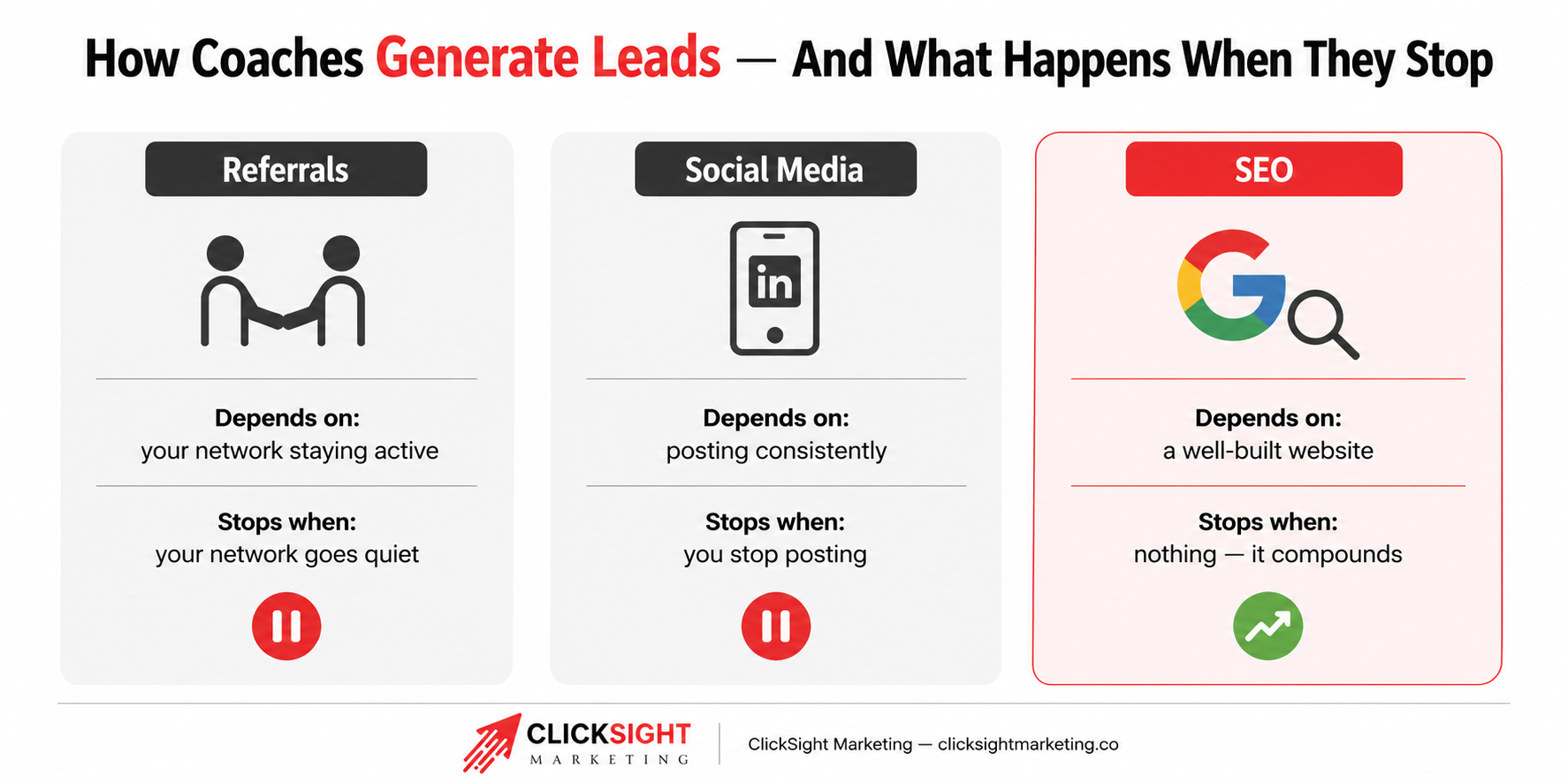
Most coaches build their lead generation entirely on two things: social media and referrals.
Both work. Neither is stable.
Referrals are relationship-dependent, they come when they come, and they dry up when your network goes quiet. Social media is algorithm-dependent the moment you stop posting consistently, your visibility drops, your reach shrinks, and your pipeline follows.
This is not a failure of effort. It is a structural problem. When you build on platforms you do not own, you are always one algorithm change, one quiet month, or one burnout phase away from a dead pipeline.
SEO solves this structural problem. Not by replacing social media or referrals — but by adding a lead source that continues working even when you are not.
One pattern I repeatedly see when auditing coaching and consulting websites is that most are not struggling because they lack expertise. They are struggling because they lack visibility.
The coach may have years of experience, client testimonials, and a strong reputation within their network. But when someone outside that network searches for help on Google, the website simply does not appear.
In many cases, the business has invested heavily in social media while the website quietly sits in the background — visible to no one outside their existing network. The result is a website that looks professional but is disconnected from how potential clients actually search for solutions.
Here is something worth pausing on.
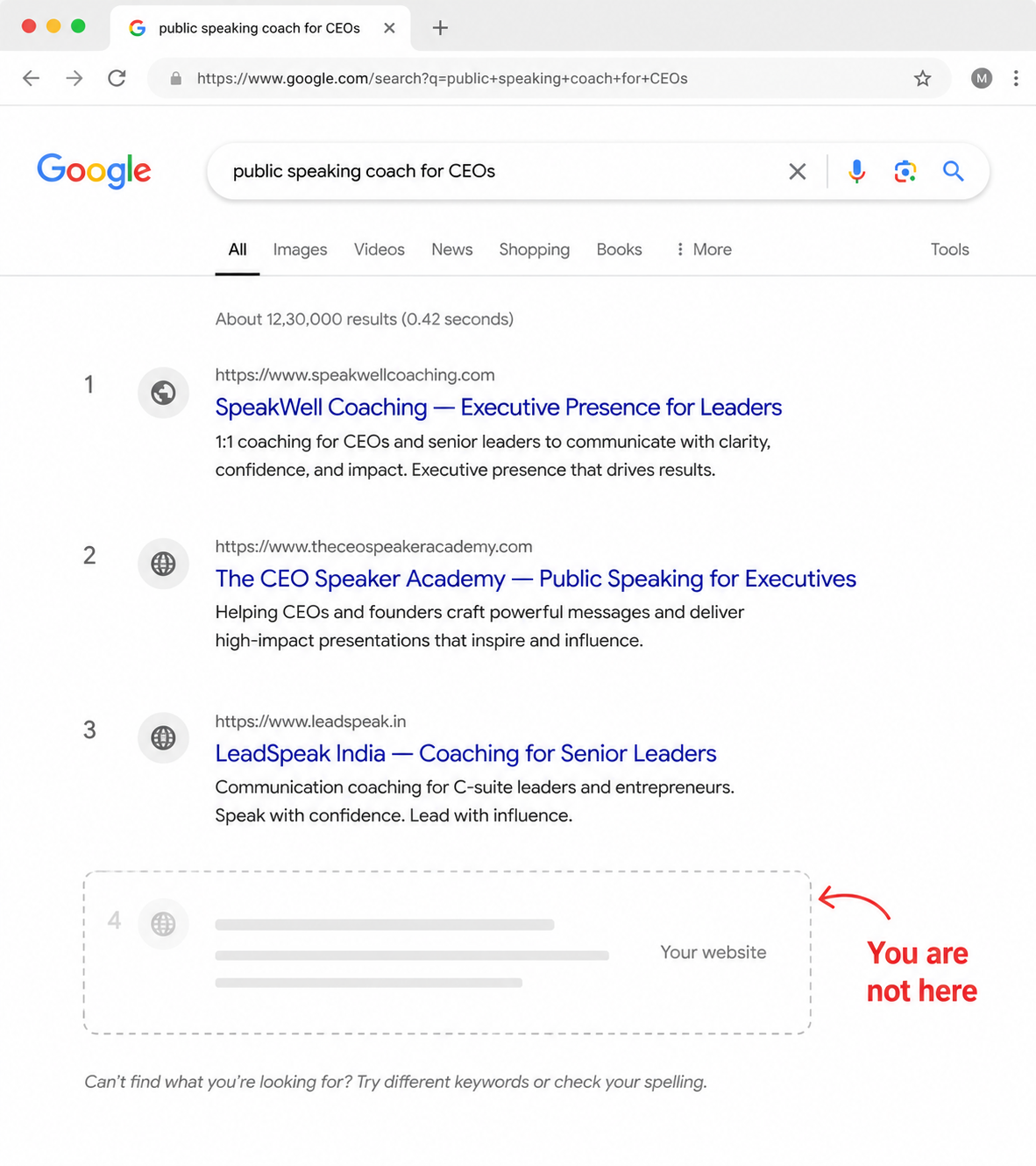
At this exact moment, someone is typing into Google: “executive coach for founders in Bangalore” or “leadership consultant for senior managers” or “public speaking coach for CEOs.”
They are not browsing. They are not scrolling. They have a specific problem, they have decided they want help, and they are actively looking for someone like you.
That person is what marketers call a buyer in motion. They have already done the work of convincing themselves they need help. They are not asking whether coaching is worth it — they are asking who is the right coach for them.
Now here is the uncomfortable question: are they finding you?
If your website is not showing up for the searches your ideal clients are making, those buyers in motion are landing on your competitor’s website, not yours. Not because your competitor is better. Because their website is visible and yours is not.
An interesting observation is that Google searches often happen after someone discovers you elsewhere.
A founder might see your LinkedIn post, hear you on a podcast, or receive your name through a referral. Before booking a call, they search your name, your coaching service, or the problem they want solved.
This means SEO is not competing with referrals and social media. It often strengthens them by helping prospects validate their decision and learn more about you before reaching out.
Many coaches have a website. Very few have a website that works.
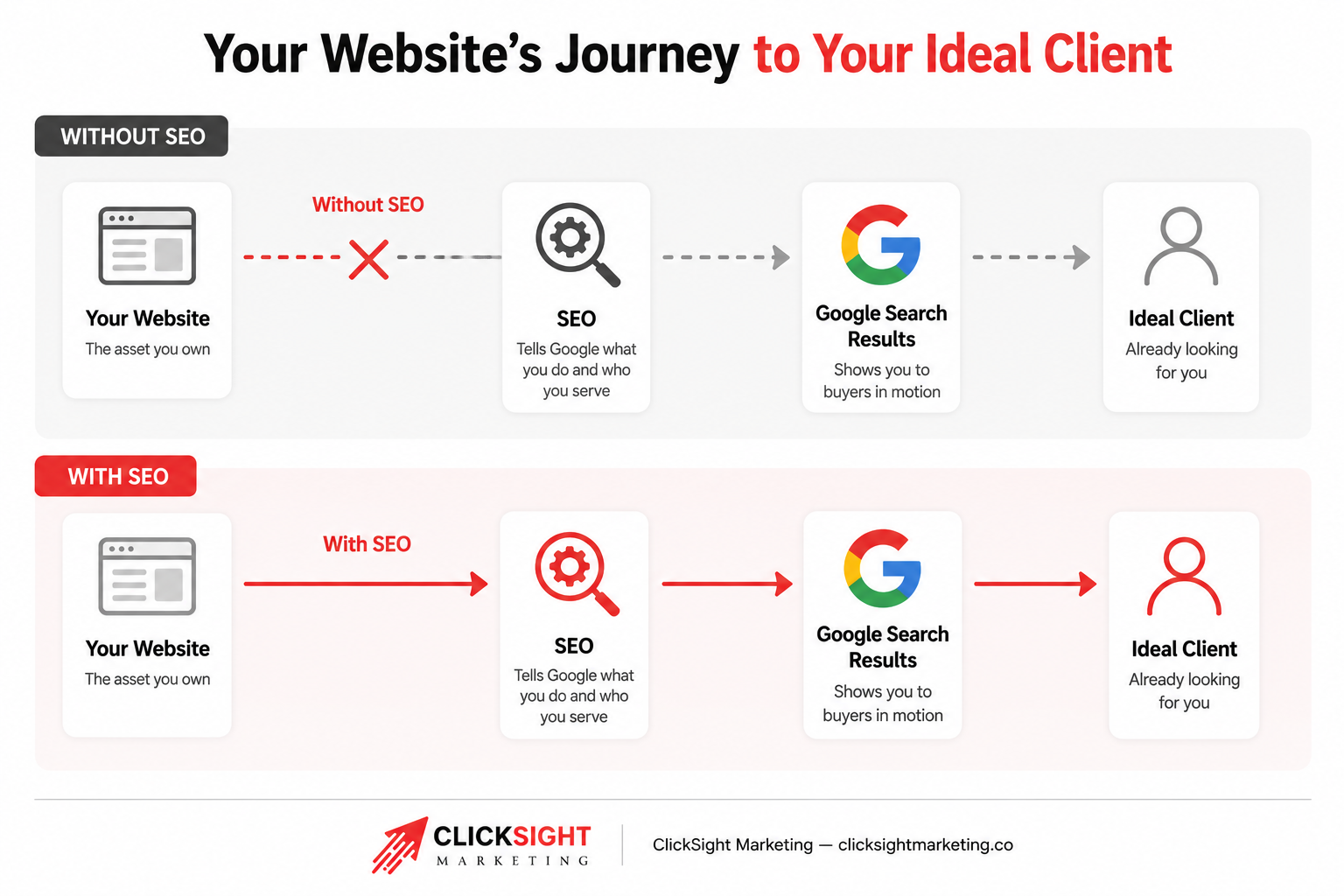
There is a difference between having an online presence and having an online presence that generates leads. A website with no SEO is like opening a coaching practice in a building with no signage, no address on Google Maps, and no way for anyone to know you exist unless they already know you.
SEO is what gives your website directions. It is how Google learns what you do, who you serve, and when to show you to someone searching for exactly that.
Without it, your website is a digital brochure — pretty to look at, invisible to find.
When a potential client finds you through a Google search, something important has already happened before they even click your link.
Think about it from the client’s perspective. If they search for “public speaking coach for CEOs” and your website comes up on the first page, their immediate assumption is that you are credible, established, and relevant. You are not a cold DM. You are not a paid ad they are already trained to distrust. You are someone Google decided was worth showing them.
That is a fundamentally different starting point for a sales conversation.
Prospects who book a discovery call after finding you through search often arrive having already explored your website, read your content, and formed an initial impression of your expertise. The conversation starts with greater context and familiarity than a typical cold outreach interaction.
Here is one experiment I would like you all to do.
Search for the services you offer. Right now, open a private browsing window and type in what your ideal client would search.
Who comes up?
If it is not you, it is someone else. And every month your website stays invisible, that someone else is having the conversations you should be having.
This is not meant to create panic. It is meant to make the opportunity concrete. Google search is not a zero-sum game you can rank alongside your competitors, not just instead of them. But you cannot rank if you never build for it.
The coaches who show up consistently in search are not necessarily better coaches. They are the ones who treated their website as a business asset and built it accordingly.
One nuance worth understanding: SEO does not only affect your website rankings.
Google evaluates your entire online footprint before deciding how to rank you. Your LinkedIn profile, your YouTube channel, your guest articles, your podcast appearances — all of it contributes to how Google perceives your authority in your niche.
A well-optimised website with strong content does not just rank your service pages. It strengthens the credibility of your entire online presence, which over time makes everything you publish more visible — across platforms, not just on your website.
We have seen this pattern repeatedly across coaching and consulting businesses. The challenge is rarely the quality of the service. More often, it is the lack of visibility when potential clients begin researching solutions.
One example comes from our work with a public speaking coach serving founders and CEOs.
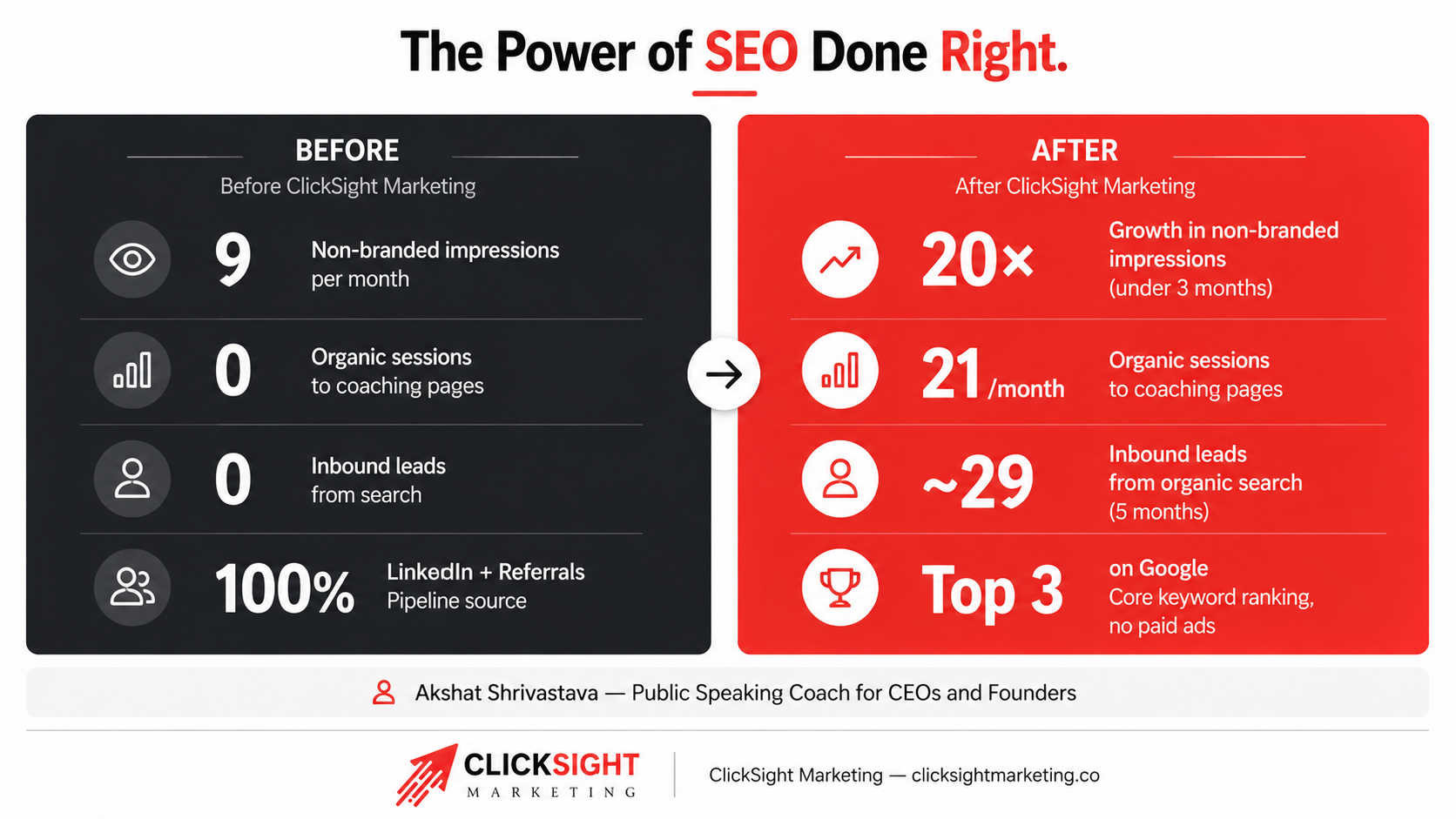
Akshat Shrivastava is a public speaking coach for CEOs and founders. When he came to ClickSight Marketing, his website was effectively invisible on Google. Non-branded impressions (people finding him through search rather than by typing his name) stood at just 9 per month. Organic sessions to his coaching pages: zero. His pipeline ran entirely on LinkedIn and referrals.
Within three months of rebuilding his website with proper SEO foundations and a content strategy built around what his ideal clients actually search for:
Non-branded impressions grew 20× in under 3 months
Coaching page sessions went from 0 to 21 per month
Inbound leads from organic search reached ~29 in 5 months
He ranked top 3 on Google for his core keyword — with no paid ads
Founders with an upcoming keynote are now finding him through search, reading his content, and reaching out — without a referral, an ad, or a cold DM.
Four months in. One well-built foundation. A pipeline that no longer stops when the networking does.
The coaches who benefit most from SEO are not necessarily the ones with the largest audiences.
Often, they are the ones with a clear niche, a strong service, and a website that helps Google understand who they serve and what problems they solve.
Visibility tends to compound when expertise and clarity are already in place.
Yes, if you want a lead source that compounds over time instead of stopping the moment you stop posting.
Yes, if you want to be found by clients who are already looking for exactly what you offer.
Yes, if you want your business to be less dependent on algorithms, referral timing, and the exhausting consistency of social media.
SEO is not a shortcut. It is not instant. But it is the one digital asset that keeps working for you even when you are not working. And for a solopreneur coach or consultant, that is not a nice-to-have. It is a structural advantage worth building.
Is SEO worth it for coaches with a small audience?
Yes. In some ways it is more valuable at that stage. A coach with a clear niche and a well-built website can rank for specific searches that a larger, more generic competitor is not targeting. SEO rewards clarity, not audience size.
How long does it take for SEO to work for coaches?
Most coaches start seeing meaningful movement in organic impressions within 60 to 90 days of implementing proper SEO foundations. Consistent traffic and leads typically build over 4 to 6 months. It is not instant, but unlike paid ads, the results compound over time rather than stopping when the budget does.
Can I do SEO myself as a coach, or do I need to hire someone?
The basics, optimising your page titles, writing content around what your clients search for, and ensuring your website loads quickly are learnable. However, most coaches find that the strategic layer (keyword research, content architecture, technical audits) is where DIY efforts stall. The question is not whether you can do it yourself but whether your time is better spent coaching.
What is the difference between SEO and social media marketing for coaches?
Social media builds visibility while you are posting. SEO builds visibility that persists after you stop. Social media is rented reach you are at the mercy of the algorithm and the consistency required to stay visible. SEO is owned reach — a well-ranked page keeps bringing in traffic without ongoing effort. The two work best together, not as substitutes for each other.
If you are a coach or consultant who wants to understand what your website’s current visibility gaps are, book a free Discovery Call at clicksightmarketing.co.
It is a 30-minute diagnostic — not a sales pitch. We will look at your website together, identify the biggest visibility gaps, and talk through whether this engagement is the right fit.