
You have a website. It looks professional. Your services are clearly listed, at least from your perspective.
But when a potential client searches Google for the problem you solve, can they actually find you?
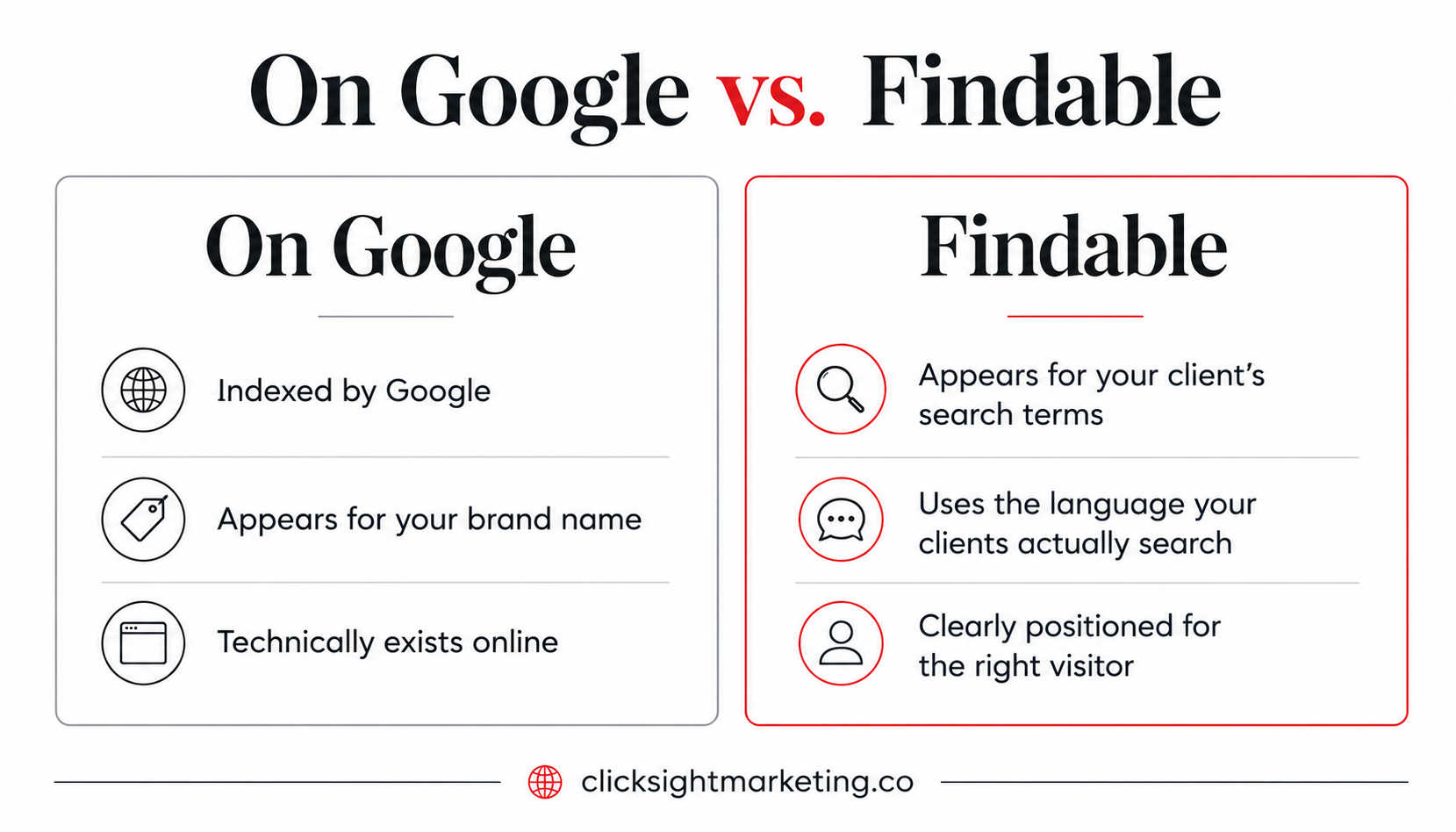
There is an important difference between having a website on Google and being visible when the right person searches for what you do. Most coaches assume these are the same thing — they aren’t, and the gap between them is usually where leads are being lost.
I see this often when auditing websites for coaches and consultants. Sometimes, Google hasn’t properly indexed the website. But more often, the website exists on Google and still doesn’t appear for the searches that could bring potential clients to it.
This quick 5-minute check will help you understand where the problem might be — whether your coaching website is actually visible to the people searching for what you offer, not just technically “on Google.”
You don’t need any SEO knowledge to do it.
Table of Contents
- Check 1: Can Google Find Your Website?
- Check 2: Does Google Know Your Website Exists?
- Check 3: Can People Find You Without Searching for Your Name?
- Check 4: Are You Talking About Your Client’s Problem the Way They Search for It?
- A Real Example From My Work
- Check 5: Can the Right Person Tell That Your Website Is for Them?
- Quick Recap: Your 5-Minute Visibility Check
- What Did Your 5-Minute Check Tell You?
- What Should You Fix First?
- Frequently Asked Questions
- How long does it take to see improvement after fixing these issues?
- Can I fix these issues myself, or do I need to hire someone?
- How often should I redo this check?
- Does this check tell me anything about how AI tools like ChatGPT find me, not just Google?
- I get most of my leads from Instagram or LinkedIn — does website visibility even matter for me?
- Not Sure What Your Results Mean?
Check 1: Can Google Find Your Website?
Start with the simplest test.
Open Google and search for:
Your service + your brand name
For example, if you’re a leadership coach with a brand called ABC Coaching, you might search:
Leadership coach ABC Coaching
Your website should ideally appear somewhere in the results, especially when your brand name is included.
If it does, that’s a good first sign. Google knows something about your website and can connect your brand with what you do.
But don’t stop here.
Finding yourself when you search for your own brand is very different from a potential client finding you when they don’t already know you exist.
We’ll check that next.
Check 2: Does Google Know Your Website Exists?
Now search Google using:
site:yourwebsite.com
Replace yourwebsite.com with your actual domain.
For example:
site:example.com
You should see pages from your website appearing in the search results.
This is a quick way to see whether Google has indexed at least some of your website.
If your pages appear, move on to the next check.
If nothing appears, your website may have an indexing or discovery problem.
The next place I would check is Google Search Console. It lets you see whether Google has discovered your pages and whether there are problems preventing them from being indexed.
If you haven’t set it up yet, connecting your website to Google Search Console and submitting your sitemap is a good starting point.
One important thing, though: this simple site: search isn’t a complete technical SEO audit. A page not appearing in this search doesn’t automatically tell you exactly what is wrong.
For this 5-minute check, we’re simply trying to answer one question:
Does Google appear to know that your website and its important pages exist?
Related reading: if your homepage and service pages are appearing but something still feels off, my On-Page SEO Checklist walks through the technical basics page by page.
Check 3: Can People Find You Without Searching for Your Name?
This is where the real visibility check begins.
Think about what you actually want someone to find you for.
Don’t include your name or brand this time.
Instead, search for the service you offer or the problem your potential client might be trying to solve.
For example:
Public speaking coach
Executive communication coach
How to become more confident speaking in meetings
Now look at the results.
Does your website appear?
If not, don’t immediately assume you have a technical SEO problem.
Your website could be indexed perfectly well and still not appear for the searches that matter to your business.
This is one of the most common problems I notice when looking at websites.
The business owner knows what they do. Their existing clients know what they do. But the website explains the service using the business owner’s language rather than the language their potential clients actually use when searching.
That creates a gap and brings us to…
Check 4: Are You Talking About Your Client’s Problem the Way They Search for It?
Imagine you have created your own methodology for helping clients.
You might have a unique name for your process. You might use certain words every day when talking to people in your industry.
But your potential client may have never heard those words before.
They’re searching based on the problem they understand.
This is something I’ve seen firsthand when auditing websites for coaches and consultants.
A website can have pages about the right general topics and still struggle to appear for relevant searches because the content isn’t aligned with how potential clients describe their problems.
So look at your homepage and your main service pages and ask yourself:
If I didn’t know my industry terminology, would I still understand what this service helps me with?
Then ask:
Are these the words my potential clients would actually type into Google?
This is where keyword research becomes useful.
Keyword research isn’t just about finding phrases with high search volumes and putting them into your website.
It helps you understand the language people use when they’re actively looking for the problem you solve.
Your website should connect your expertise with that language.
A Real Example From My Work
I saw this combination of problems while working on the website of Akshat Shrivastava, a public speaking coach for CEOs and founders.
Before we worked on the website, its search visibility was extremely low. Google Search Console showed only around nine search impressions during the period we initially looked at.
The problem wasn’t just one missing SEO setting.
The website needed a clearer foundation.
We rebuilt the website from scratch, worked on his positioning, researched what potential clients were actually searching for, and structured the website around the services he wanted to be found for.
We also set up the website properly in Google Search Console so we could see how Google was discovering and displaying it.
The important lesson wasn’t simply that submitting a website to Google fixes its visibility.
It doesn’t.
Google first needs to be able to discover your website. Then it needs enough context to understand what your website is about and which searches your pages are relevant to.
That’s why I look at both sides when checking a website:
Can Google access and understand the website?
And:
Is the website actually talking about what the right audience is searching for?
You need both.
If you want the full breakdown of what changed and what it led to, I’ve written it up in more detail in this case study.
Check 5: Can the Right Person Tell That Your Website Is for Them?
Now forget about Google for a moment.
Open your homepage and look at the first section.
Imagine you’re seeing it for the first time.
Within a few seconds, can you answer these questions?
Who is this for?
What problem does this person help me solve?
What should I do next if I’m interested?
This is one of the biggest problems I notice when auditing websites for coaches and consultants: unclear positioning.
Someone lands on the website, reads the headline and still can’t confidently tell:
Is this actually for someone like me?
SEO can bring someone to your website.
It cannot fix unclear positioning once they arrive.
And positioning can affect your search visibility too. If your website tries to talk about everything you can possibly do, it becomes harder to create focused pages around the specific services and problems you want to be found for.
Your website doesn’t need to explain everything you know.
It needs to make the right person think:
This is exactly what I was looking for.
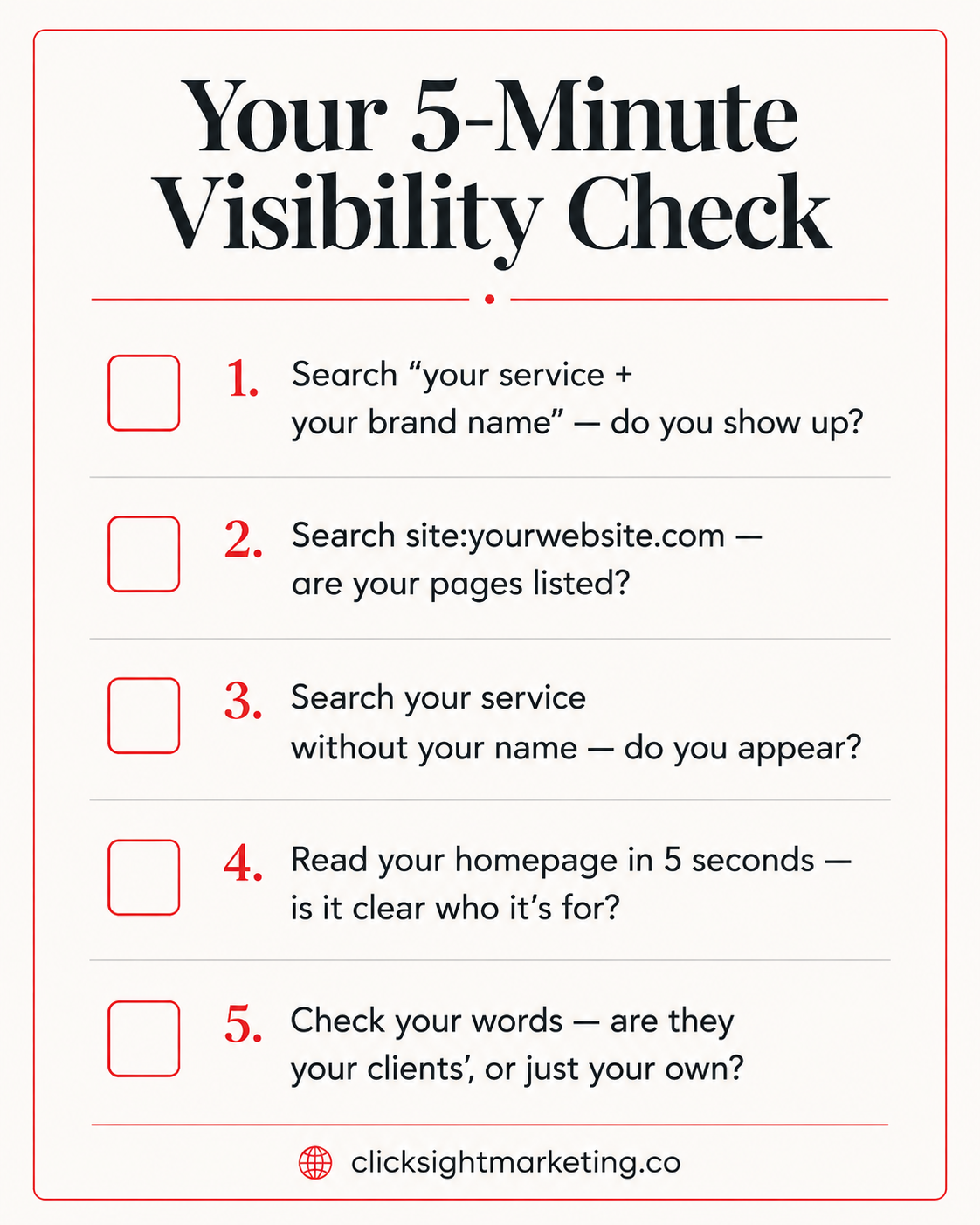
Quick Recap: Your 5-Minute Visibility Check
What Did Your 5-Minute Check Tell You?
By now, you should have a better idea of where your visibility problem might be.
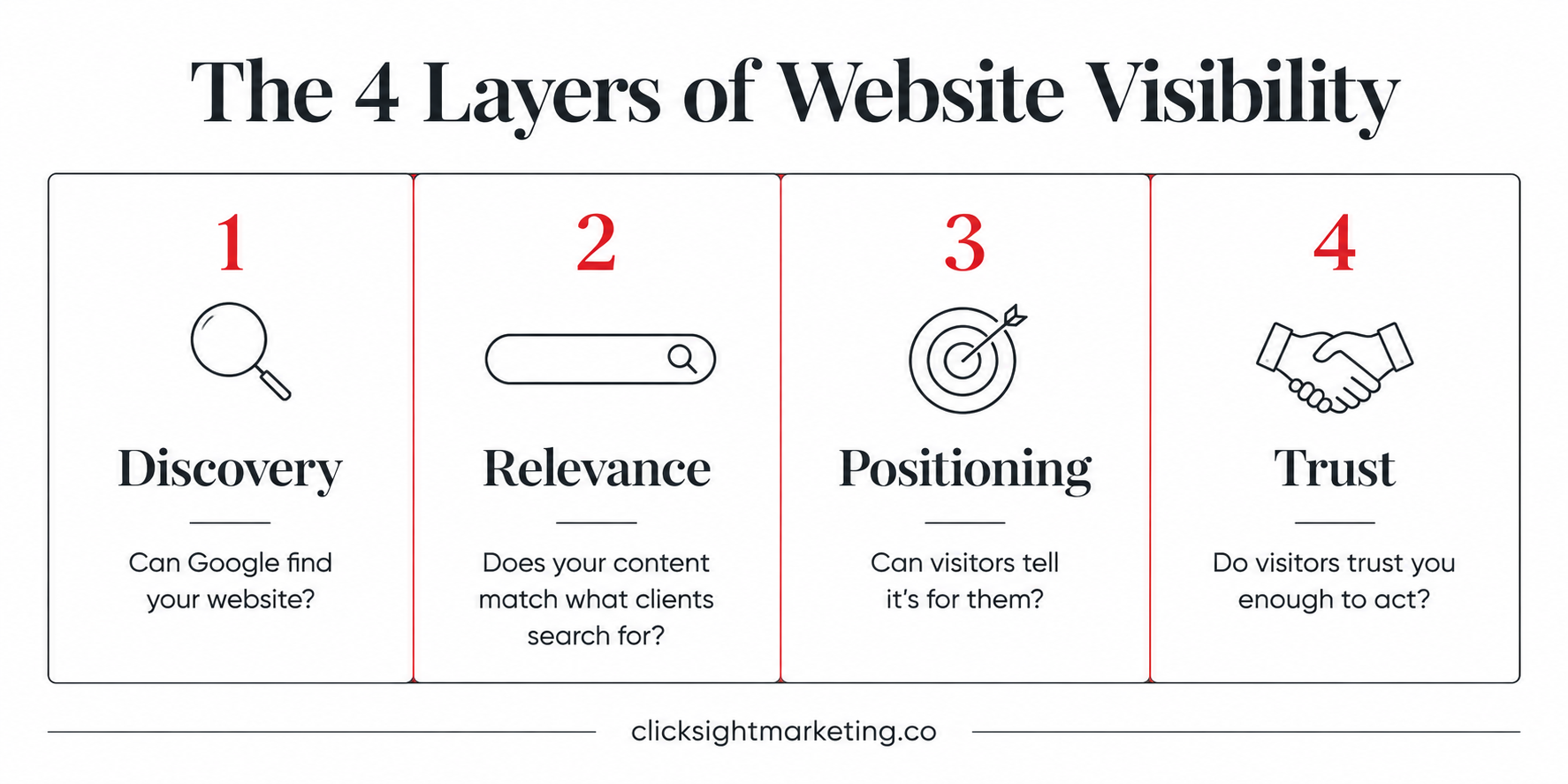
If Google doesn’t seem to know your website exists, you may have a discovery or indexing problem.
If Google knows your website exists but you aren’t appearing for the searches that matter, you may have a content and search relevance problem.
If your website appears in search but people can’t quickly understand who you help or why they should choose you, you may have a positioning problem.
And if people are finding your website, understanding your offer, but still aren’t becoming leads, you may have a trust or conversion problem.
That last one is important.
This 5-minute check can help you identify where to investigate. It cannot tell you whether your entire SEO strategy is working or guarantee that your website will convert visitors into clients.
Visibility gets people through the door.
Trust is what helps them take the next step.
What Should You Fix First?
Start with the earliest problem in the journey.
If Google hasn’t properly discovered or indexed your important pages, fix that first. Set up Google Search Console, check your indexing status and make sure your sitemap is submitted.
If your website is indexed but you’re not appearing for the searches that matter, look at your content.
Ask whether your website clearly communicates what you do and whether you’re using the language your potential clients use when searching for their problems.
If both of those things are working, look at your positioning and the experience someone has after landing on your website.
Don’t try to fix everything at once.
First, identify where the gap is.
Then fix the right problem.
Frequently Asked Questions
How long does it take to see improvement after fixing these issues?
It depends on which problem you found. Indexing issues can resolve within days once Google recrawls your site. Content and positioning changes usually take longer to show up in rankings — often a few months — since Google needs to reassess how relevant your pages are for the searches you’re targeting.
Can I fix these issues myself, or do I need to hire someone?
The indexing check and Search Console setup are things most coaches can handle on their own. Rewriting your content around the language your clients actually search for, and fixing positioning without losing what makes your offer distinct, is where most people benefit from another set of eyes — it’s easy to be too close to your own business to see how it reads to a stranger.
How often should I redo this check?
I’d revisit it any time you significantly change your website, your offer, or your positioning — and otherwise every few months as a general health check. It’s not something that needs constant monitoring, but it’s useful to catch drift before it becomes a bigger problem.
Does this check tell me anything about how AI tools like ChatGPT find me, not just Google?
Not directly — this check is built around traditional Google search. But the same underlying issue matters for both: if your website doesn’t clearly state what you do and who it’s for in language your clients would recognize, it’s harder for AI tools to surface you too. The two aren’t identical, but they’re not unrelated either.
I get most of my leads from Instagram or LinkedIn — does website visibility even matter for me?
It matters more than it might seem. Social visibility depends on you posting consistently — if you stopped tomorrow, that channel goes quiet with you. A website that’s actually visible and clear keeps working even when you’re not actively posting, which makes it a more durable source of inbound leads over time.
Not Sure What Your Results Mean?
Sometimes the website is on Google, the pages are indexed, and everything appears technically fine.
Yet the right clients still aren’t finding it.
That’s usually when the problem requires a closer look at how your positioning, website content and search visibility work together.
If you’re not sure where the gap is, you can book a discovery call with me. I’ll help you understand whether the problem is with how Google sees your website, what you’re trying to be found for, or how your website communicates your value to potential clients.
Related reading: not sure SEO is even the right investment for your practice? I break that down in Do Coaches and Consultants Need SEO?